
INSIGHTS
For Such A Time As This:
J Street Convention 2026 Amidst Escalating War and Waning Democracy
by Rabbi Ariel Naveh
The holiday of Purim is a strange one. While broadly it adheres to the colloquial heuristic of Jewish holidays – “they tried to kill us, we won, let’s eat” – the holiday’s celebratory joy stands in contrast with the near-obsessive final verses of the Megillah, focused on the downfall not only of Haman but of his entire lineage. No doubt it’s always been one of my favorite holidays to celebrate, but the question must be raised: when does conquest over an imminent threat to your livelihood and your people turn into outright bloodlust? At what point is vengeance sanctioned, and what happens when it is driven to excess?
I had the opportunity to grapple with these big questions at this year’s February 28-March 2 J Street Convention. Just the evening before the Convention was to start, President Trump, in concert with Bibi Netanyahu, launched an all-out military assault on Iran. They claimed, with little evidence, that an attack on Israel was imminent and it was in the interest of Americans and Israelis alike to annihilate the country and its leadership.
The Convention’s theme of “Regional Peace and Resilient Democracy” took on even greater meaning, and became even more fraught as the first thing one saw on the Convention app was J Street’s full-throated statement opposing the war in Iran. Partners for Progressive Israel released its statement soon thereafter. J Street’s statement called the war “reckless,” and condemned the Trump and Netanyahu administrations for forgoing numerous attempts at diplomatic strategies and resolutions, including abandoning the JCPOA, the 2015 Joint Comprehensive Plan of Action, signed by Iran, the European Union, and the five permanent members of the UN Security Council. Sadly, three weeks into this needless war, we are witnessing exactly how reckless this war has become, with Iranian families fleeing constant bombardment, Israelis attempting to recreate normalcy in bomb shelters, and Palestinians facing even further elevated levels of state-sanctioned violence by settlers.
Yet I knew that representing Partners for Progressive Israel at our table in the exhibition hall, engaging in so many holy conversations with so many participants about our work and our mission, while listening to their own stories about and struggles with Israel and Palestine, was all the more necessary because of this war, and the damage it would inflict throughout the entire region. This was also the first opportunity we had to hand out palm cards with a QR code that links to Partners’ recent publication, “Discussing Genocide: A Guide for Reflection and Discernment.” This was – perhaps counterintuitively – probably the best conversation starter I’ve ever had in all my years of tabling. It was clear that people really do want to talk about genocide, whether they agree with the usage of the term in this particular context or not. But more importantly, people – rabbis, educators, lay leaders – want the opportunity to ask the big questions they are struggling with right now about what it means to be a Jew who has a relationship of any kind with Israel and Palestine.
As we have seen, the war in Iran has only given further cover for the heinous actions the Israeli government has taken against Palestinians in the West Bank and Gaza, and now in Lebanon as well. Speaking on these issues as a rabbi, lay leader, or educator can be challenging, especially as antisemitic rhetoric attempting to conflate these actions with the entirety of the Jewish people is on the rise. The fact that these conversations came with a discussion guide and free chocolate meant that the PPI table was buzzing throughout the Convention.
That, to me, is what made the Convention space feel so vital. To listen to, engage with, and be in relationship with so many of the smartest and most empathetic leaders in our community and beyond meant that we were equipped with frameworks for these difficult questions about how we advocate for democracy here and in Israel/Palestine, especially when we are witnessing its calculated demolition in real time.
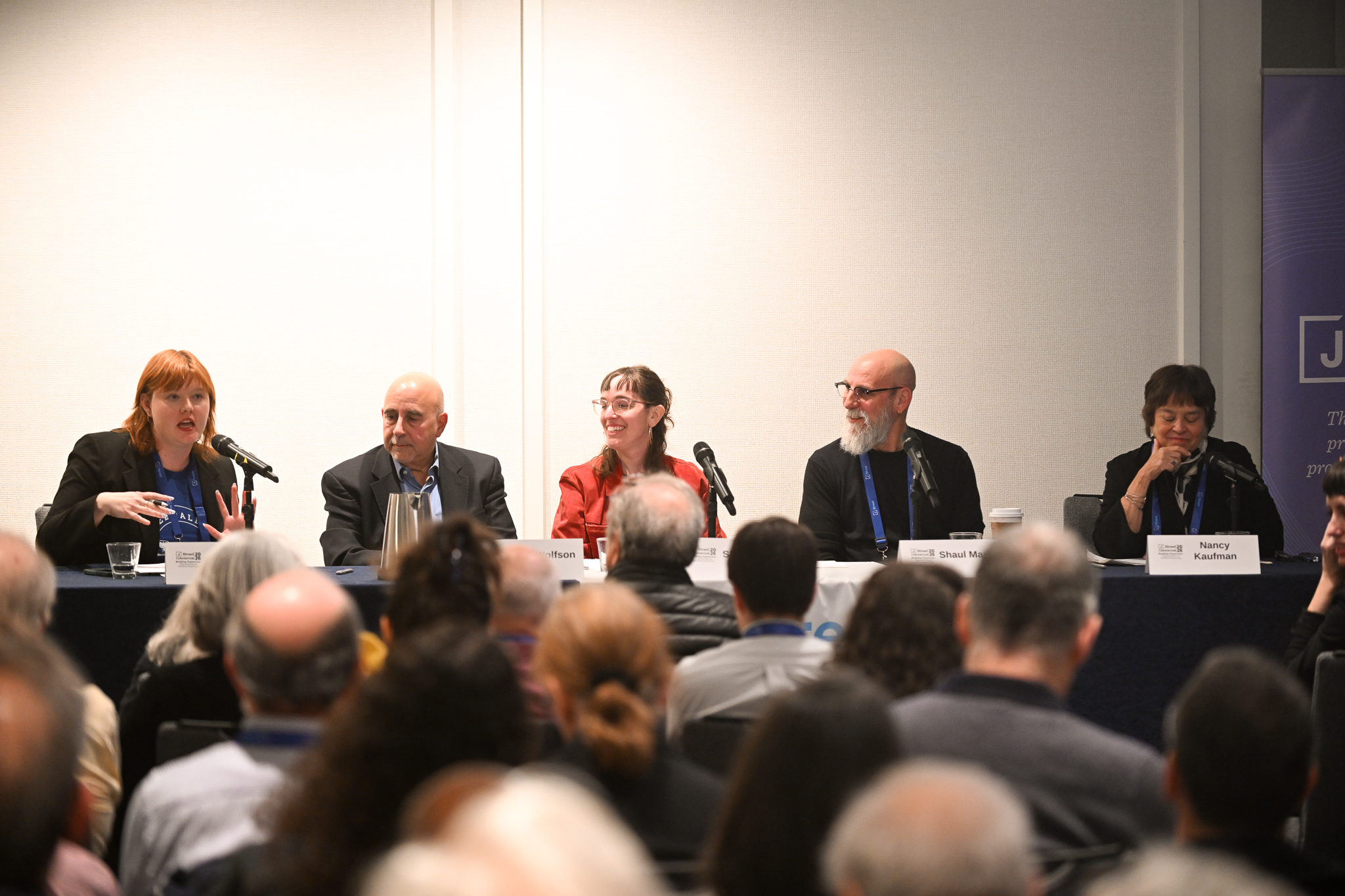
The message we heard from so many at the Convention about maintaining democracy was to keep being in relationship with each other. Over and over, through plenary discussions like the incredible conversation between Rabbi/Ambassador David Saperstein, Maya Wiley, Amy Spitalnick, and Reverend Malcolm Byrd, we were reminded how our struggles for democracy and safety in the Jewish community have for generations been bound up in the safety of the Black diaspora here in America. Leaders from Standing Together and New Israel Fund, and activists like Maoz Inon and Aziz Abu Sarah, showed us that the only way forward for Israelis and Palestinians is together. While these sentiments were echoed by Israeli politicians like Yair Golan and Ehud Olmert, it’s very clear that real change will continue to come from the ground up. Standing Together in particular has been at the vanguard of mobilizing, educating, and training Israelis and Palestinians on a supremely local, grassroots level, often surpassing the efforts of the opposition leaders. That they have managed to gain municipal electoral success is a significant testament to this hyperlocal work.
Everyone present at the Convention understood that a democracy can only function when the people living within it see themselves as equally responsible for maintaining it, while also reckoning with what happens when the ties that bind us fray. We must ensure that the last verses of the story of Purim are used as a bulwark, a warning about the dangers of weaponizing our own victory over persecution, and not as a call for overwhelming violence towards future generations of our enemies, real or imagined.
One of the real highlights of the Convention was watching “Coexistence My Ass!”, comedian and activist Noam Schuster-Eliasi’s hilarious and deeply moving documentary, which grapples with exactly those questions. Noam was raised on an Israeli kibbutz devoted entirely to coexistence between Israelis and Palestinians, and she describes her struggles with how the values she was taught stand up to the trauma of October 7th, and the continued onslaught of terror and pain that Palestinians have faced since. There are no easy answers from this film, and at times, Noam looks on the verge of despair, as she navigates her relationships with Israeli and Palestinian friends and family. She is also very, very funny, and is able to show how mordant humor is necessary in advocating for real structural change. And while Noam was unable to join us in person as she just had her very first child, the film’s distributor, Libby Lenkinski, and one of Noam’s friends and fellow comedians, Yossi Zabari, described how necessary and how revolutionary art is in standing up against fascist governments.
It was a strange and surreal coincidence that this war in Iran happened upon the holiday of Purim. Unfortunately, this coincidental timing has been used by many both to justify the war, and to dehumanize the Iranian people by linking them to the Biblical Amalek, the perpetual enemy of the Jewish people. This is an intentionally despicable misinterpretation of the text and its themes. In the Megillah, Mordecai tells Esther that perhaps for such a time as this she was put into a position to influence the men in power against the destruction of the Jews of Persia. But, unlike the Purim story, this war was in no way inevitable, and the people who are caught in its crosshairs are not our enemy. I see Mordecai’s words, rather, as a call to action, telling us that, especially in times as fraught and troubling as now, we have a responsibility to speak truth to power. The J Street Convention reminded us that none of us are exempt from keeping democracy afloat here and in Israel/Palestine.

Rabbi Ariel Naveh is a rabbi, educator, and organizer living on Long Island. He’s currently working as the Field Director for the Town of North Hempstead Democratic Committee, and serves on the board of Partners for Progressive Israel.
Leave A Comment