
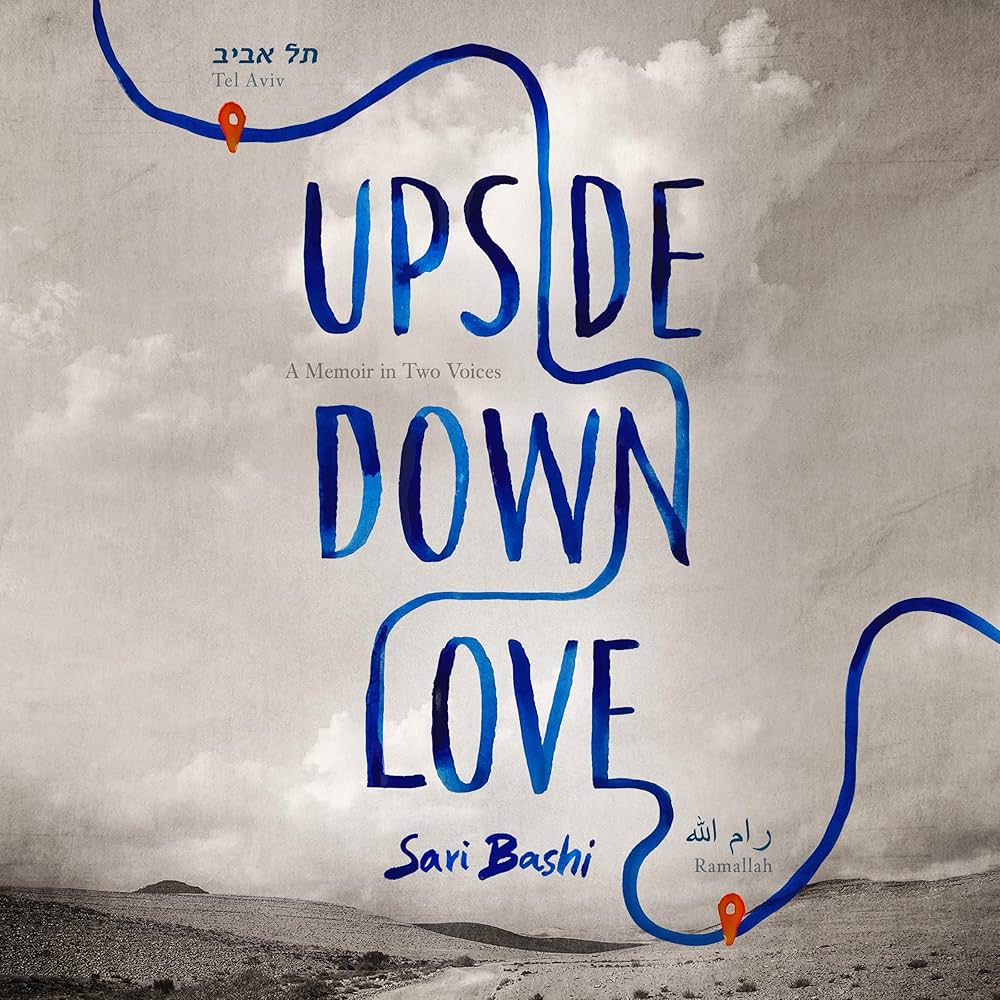
Sari Bashi, Upside-Down Love: A Memoir in Two Voices. (Blackstone, 2026)
By Rabbi Margo Hughes-Robinson
“Could you write me a sign in Arabic that says, ‘My name is Sari Bashi, and I’m an Israeli-American Jewish woman in love with a Palestinian man named Osama Fahed. The two of us are just people, and I would be grateful if you could please respect that.’”
This line comes near the end of “Upside-Down Love: A Memoir in Two Voices,” recently published in English translation by Sari Bashi and her husband Osama Fahed (a pseudonym), but it serves as a wonderful introduction to the relationship at the center of the book. Alternating chapters written by Bashi and Fahed over the course of their relationship track the evolution of their unlikely connection: first as lawyer and client, then as friends, lovers, and eventually building a family together.
Bashi founded Gisha, an Israeli non-profit dedicated to protecting the freedom of movement of Palestinians, and initially met Gaza-born Fahed when he was living and working in the West Bank. He was attempting to travel to London to pursue his doctoral studies when he connected with Gisha to legally represent him in his case. Four years later, the two met again in Ramallah and began to fall in love, subsequently drafting early chapters of the book that would be published ten years later in Hebrew, in 2020 (originally titled “Maqluba,” a nod to the overturned pan in the traditional Palestinian dish).
In many ways, their relationship is like that of so many other couples around the world: Sari and Osama meet, experience attraction, decide to pursue a relationship. They navigate their work commitments, their hobbies, go on vacation together, consider getting to know each other’s families. They break up and reunite, sharpen their mutual understanding, make space for each other and move in together, and exchange doubt and determination about whether to have children. What is unique is not their trajectory, but the circumstances under which it evolves.
Perhaps Bashi and Fahed’s strongest suit as a literary couple is their sense of ironic contrast, which is woven throughout the book. Bashi is a competitive long-distance runner, and especially after she moves in with Fahed in the West Bank, her on-foot travels through different areas of Palestinian civil and Israeli military administration provide a kind of punctuation to her growing intimacy with her partner. As she runs and alternately processes the relationship’s ups and downs (or immerses herself in running so completely as to momentarily ignore them) she encounters – or rather, is encountered by Palestinian villagers and city-dwellers, Jewish settlers, and Israeli soldiers, all of whom alternately call out the irregularity of encountering her on roads between checkpoints and unmarked towns, or who see whoever is most convenient for them. Depending on the interaction, Bashi is observed as a Jewish Tel Avivian, a Palestinian, a secular settlement-dweller, or an American tourist. Fahed, by contrast, is always Palestinian– and often not able to accompany his partner as she transgresses boundaries both cartographically and socially.
Often, the two authors deftly weave together the moments where their personal life, Sari’s professional work, and Osama’s legal status overlap acutely. It is these flashpoints where the impact of the Occupation feels sharpest: no longer the background against which they fall in love, but almost a third party in their relationship. When Sari and Osama decide to move in together, Sari reviews all of the Israeli laws that impact their lives: the 1954 legal decisions that keep Osama’s mother in Gaza, despite the fact that she was born in a Palestinian village near what is today Ashkelon in Israel; the 1967 law that kept Osama’s father in Egypt, apart from his family in the Jabaliya refugee camp in Gaza; the host of post-Oslo statues that forbid Osama to live in Tel Aviv with Sari, and Sari to move to Ramallah with Osama.
Years later, when their daughter Forat is born in an Israeli hospital and requires a NICU stay, a Jewish family friend registers as Forat’s father in order to visit a convalescing Sari and Forat, and Osama must wait a month until his partner and daughter can come home. Poignantly, this is not the first time Osama has experienced this kind of delay: his ex-wife and his teenage son are also Israeli citizens (although as Palestinians, they could move to Ramallah legally), and Osama could not be present at his birth, either.
As Bashi and Fahed narrate the building of their Jewish-Muslim-Israeli-Palestinian family in the West Bank, they also turn their narrative gaze back to their own family histories, encouraging the reader to reckon with the historical instability of their identities. Less than a century before they met, both the Bashi and Fahed families were subjects of the Ottoman Empire, in Iraq and in Palestine. Both families spoke Arabic, albeit in different dialects. Bashi and Fahed explore how the legal designations and papers that complicate their family’s existence in the present are recent inventions, not immutable categories of existence and identity in the ways the Occupation attempts to concretize. Bashi notes the tensions present at her family’s own mixed Ashkenazi and Iraqi gatherings with new eyes, seeing her family through Osama’s label of “Arab Jews;” while Osama observes his own family’s increasing religiosity and social conservatism in Gaza (alongside, he notes, a growing penchant for lewd humor as a distraction throughout the enclave as conditions degrade).
While Maqluba was published in Hebrew in 2020, this English edition arrives two years after the devastating Hamas terror attacks of October 7th, 2023, and the subsequent Israeli war of retaliation and destruction – even annihilation – in Gaza. The book is dedicated in part “to the beloved people of Gaza, with hope and apology,” and the new English language epilogue ends with an emotional insistence that, “there are good, loving people here [in Israel-Palestine] who are working for a better future.” Throughout the war, Bashi has published op-eds in the New York Times about her Gazan mother-in-law’s forced displacement, and how it informs her own thinking about the Palestinian right of return. Ahead of the publication of “Upside-Down Love,” she retold the story of her relationship with Osama in another Times piece, sharing how their now-family of four had navigated the destruction of Gaza, fearful for their relatives.
In my own conversation with Bashi last February, I drew a connection between her partner’s practice of wearing a ribbon on his lapel that counts the days since the war in Gaza began, and the practice of many Israeli hostage family members and their supporters of wearing a piece of tape on their shirts with the same count, innovated by Rachel Goldberg-Polin. Under very different circumstances, but at the same time, I had realized, these practices were an outward manifestation of fear and hope for one’s beloved family members, trapped in the enclave. “I’m so glad that you see them as similar,” Bashi replied, “empathy and love cannot be selective”.
It’s tempting to read “Upside Down Love,” through a kind of “love conquers all” lens, but to do so would be a disservice to the lived reality of its authors and to the very necessary work that they do professionally. Instead, to quote Bashi’s op-ed last summer, we have to acknowledge, “Love isn’t enough to protect us — or anyone — but we plan to use it as a shield for as long as we can.”

Rabbi Margo Hughes-Robinson is the Executive Director of Partners for Progressive Israel.

Leave A Comment