
INSIGHTS
Jackie Robinson and the Jewish Question
By Peter Eisenstadt
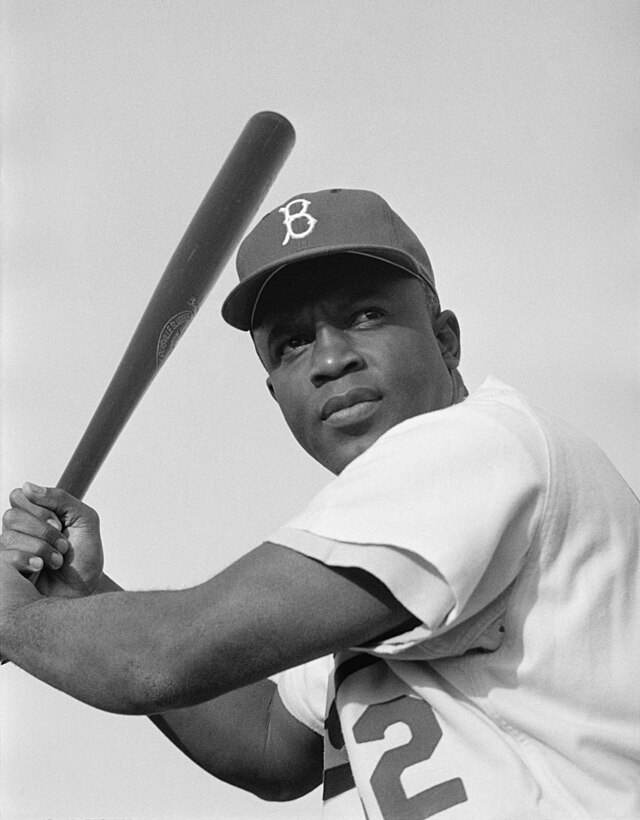
I was recently chatting, via email, with Hillel Schenker, longtime Israeli peace activist and longtime friend of Partners for Progressive Israel. The conversation came around, as they often do for me nowadays, to the topic of Jackie Robinson. Hillel told me that he was once interviewed and asked who was his inspiration for his decades of work on Israel-Palestine peace efforts. A Jewish peace activist perhaps, like Martin Buber or Judah Magnes? No. Growing up in Brooklyn in the 1950s, his childhood role model and inspiration for a life dedicated to Jewish-Palestinian understanding and rapprochement was Jackie Robinson. Hillel was not alone. I have collected other stories of young men, primarily young Jewish men, growing up in the baseball-mad, half-Jewish borough that was Brooklyn in the early 1950s who cited Jackie Robinson as the inspiration for a life dedicated to the pursuit of social justice.
Why Jackie Robinson? Jackie Robinson was the first African American to play major league baseball in the twentieth century when he joined the Brooklyn Dodgers on April 15, 1947. (And let me point out that exactly one month later on May 15, 1947, in a building in Flushing Meadows Park, in Queens, not far from where the New York Mets have played baseball since 1964, and in the area where Robert Moses offered to build a stadium for Walter O’Malley, the president of the eager-to-relocate Brooklyn Dodgers, though O’Malley, seeking his fortune elsewhere, spurned Moses’s offer, the General Assembly of the United Nations formed the United Nations Special Committee on Palestine, i.e. UNSCOP.) Jackie Robinson’s career would track the birth and early years of Israel. He played his last major league baseball game on October 10, 1956, about two weeks before Israel invaded the Sinai Peninsula to start the Suez War.
There were many reasons for the specific Jewish identification with Jackie Robinson. (The only film Hillel remembers his grandfather taking him to see, at his insistence, was The Jackie Robinson Story, a 1950 potboiler in which the role of Jackie Robinson was played, fairly creditably, by Jackie Robinson.) Jackie Robinson cracked the color line in baseball with a superabundance of athletic talent, along with matchless courage. He was an outspoken advocate for civil rights and other political causes during his years with the Dodgers, and after his retirement until his much-too-early death in 1972.
For Robinson, the fight against racism and the fight against antisemitism were deeply entangled. As early as 1949 he supported Jewish causes, when a “food train” of 80 trucks with a million pounds of foodstuffs intended for Israel motorcaded before City Hall in Manhattan with a reviewing stand that included Robinson and master of ceremonies Ed Sullivan. More substantially, he became a spokesman for the Anti-Defamation League, an organization whose savvy and smarts he much admired. He continued to call out antisemitism, particularly Black antisemitism, his entire life. Besides which, many of Jackie Robinson’s most supportive sportswriters and most ardent fans (such as Hillel) were Jewish. And as they say, many of his best friends were Jewish, including many of his most welcoming neighbors. The Robinson family’s favorite vacation spot was Grossinger’s, in the heart of the Borscht Belt. Many of his business partners were Jewish, such as the Lithuanian-born William Black, né Schwartz, president of the Chock Full o’ Nuts coffee and luncheonette chain, where Robinson was a VP from 1957 to 1964. One of the foundations of his politics was his oft-stated belief that “very frankly the Jew has been our [Black folks’] greatest ally. We go back even before the Negro started pressure in civil rights, and the Jew was there working with their organizations.”
The literature on (or exposing the myth of) this supposed golden age of Black-Jewish political harmony is voluminous. To the extent this era existed, Jackie Robinson was perhaps its avatar. He appreciated Jewish power and Jewish economic success, and Jewish organizations always liked his claims that anti-Black racism and antisemitism were deeply entangled. He approached racism and antisemitism as most liberal Jews wished to cast the issue, not as parochial grievances, but as the expression of a universal cause. In 1957 he told a Chicago audience that “in our struggle for civil rights we must not be motivated by color but by our love of God and for freedom. I would resign as head of the campaign [for the Freedom Fund of the NAACP] if I thought the NAACP was fighting for the rights for Negroes alone.” He exploded the dilemma of mixed or dual loyalties, maintaining that there was no conflict needing resolution. Black first or American first? He answered in 1964 that “I am a Negro first, because down through the centuries, we have proven that we are the most loyal Americans.” Many American Jews felt the same way about their Jewishness, that they were proud to be Jewish precisely because it was uncontaminated by ethnic or religious particularism, and in that way they were the purest Americans, believers in an America where, as King put it at the March on Washington, every person shall be judged not by any extraneous criterion, but “by the content of their character.” In early 1960, in a column about antisemitism in Europe and the specter of the “revival of Hitlerism,” Robinson penned as eloquent a statement of civil rights universalism as one could imagine: “Since every last one of us is a member of some vulnerable minority—whether it be by race, religion, national origin, political party, education, occupation or other differences—none of us is safe once group-hate is unleashed against any other.”
But by the 1960s the Black-Jewish alliance was foundering on the basis of class differences, Jewish shopkeepers and business people in Black neighborhoods, Jewish suburbanization, and Black ghettoization. (Israel, before 1967, was only a minor irritant.) Black people had concluded, to greatly simplify, that the Jewish model for advancement in American society was not working for them. And Jews became afraid that the different paths that Black communities were pursuing would endanger Jewish success. And despite Robinson’s deep support for Jews and Jewish causes, in that great parting of the ways between Black and Jewish organizing that was the New York City Teachers Strike of 1968, Robinson’s sympathies were with the Black decentralizers, not with the largely Jewish teachers’ union. Still, even in its aftermath he continued to support Jewish causes, writing in 1970 that “Blacks should be just like ‘the Jews who support Israel strongly…Whenever any other ethnic group is threatened they protest. That is what Blacks must do.” However, it is true that Robinson really never had much to say or do about Israel and the Middle East. (Unlike his close friend, fellow supporter of integration, fellow athletic star at UCLA [basketball in the 1920s], and fellow and often twinned exemplar of ultra-high African American achievement, Ralph Bunche, but that is another story.)
However, the question remains. Could or should Jackie Robinson inspire peace activists in 2026, the way he inspired Hillel Schenker in the 1950s? I think his breaking of the color line in major league baseball and his all-around athletic excellence are too far in the past to inspire similar adulation. But his post- Dodgers career as a civil rights advocate just might.
He was always outspoken, never afraid to speak his mind, never afraid to offend. He knew what he wanted: full citizenship for African Americans and all racial minorities and all minorities. But he was unsure about the best way to achieve it. He would work with the powerful, presidents and would-be presidents, and rally and inspire the powerless, and he was someone who knew the necessity, the advantages, and the pitfalls of both. He was always willing to call out Black leaders, including those he usually agreed with. There was no organization he was more associated with than the NAACP, though he regularly criticized it and its head, Roy Wilkins, for their standpattism. In general, as a civil rights activist, he often found the Black liberals too accommodating, too willing to be satisfied with what amounted to superficial changes, and the Black radicals too impractical, too demanding of what he deemed impossible.
He was not perfect. His political judgment was sometimes off. I can understand why he was an anti-Communist in the 1940s and 1950s. He thought that unless white people thought supporting civil rights would help defeat the Soviet Union they wouldn’t be interested, and he was probably correct. And there were of course plenty of legitimate criticisms to be made of the Soviet Union and American Communism. Still, that did not justify his testimony against Paul Robeson before the House Un-American Activities Committee in 1949, or his support for Richard Nixon’s presidential bid in 1960, a misstep for which he subsequently repented. But political perfection is neither possible nor desirable. Fight the Mt. Rushmore-ization of our heroes. We do not need to measure ourselves against an impossible-to-meet standard. We must take our stands on controversial issues amid the fray.
He was combative, but usually generous to his allies in disagreement. He believed in Black unity, but not at any cost or price. He defended the War in
Vietnam much longer than he should have. When Martin Luther King Jr in 1967 sharply criticized the war in Vietnam, Robinson thought King was “utterly wrong” but he insisted that King was “still my leader… because I would not want bigots and those who secretly disagree with him to find comfort in my disagreeing with him.” But by the fall of 1968, with King in a freshly dug grave, he sounded more like Black radicals such as Stokely Carmichael than King: “Black people are not afraid to die and there are hundreds of thousands of young Black people who would rather make a last- ditch stand for freedom in the ghettoes of their cities than in the jungles of Vietnam.”
He knew what it felt like to become bitterly disillusioned with something he had formerly deeply believed in. Always a patriot, by 1971 he could tell the New York Times that he “wouldn’t fly the flag on the Fourth of July or any other day. When I see a car with a flag pasted on it, I figure the guy behind the wheel isn’t my friend.” He hoped that the pendulum would swing back to a better America. I hear you Jackie. And I feel the same way about the American flag. And the Israeli flag, too. And about the desperate hope that the American and Israeli pendulums will once again swing in our direction.
Whatever else he was or was not, Jackie Robinson was definitely a philosemite. There has been a lot of talk recently about defining antisemitism. But philosemitism is probably even more difficult to define. If antisemitism is on the rise, philosemitism definitely is not. Jews are a tough people to love these days. But if, as Jews, we must love the Jews, let us love our fellow Jews in the way Jackie Robinson loved his fellow African Americans, with a scorching, lacerating love, while seeking the largest possible community of support for what we believe in. I have never cared for the phrase, “two Jews, three opinions,” since Jews are as susceptible to group-think as any other people, and when it comes to Israel, until recently, the attitude of American Jews has often been “three Jews, one opinion,” with anything beyond the mildest criticism of Israel likely to get one exiled to the Pale of Forbidden Sentiments. I love the way many too-long suppressed Jewish voices are now loudly being heard, and that many American Jews are undergoing long overdue agonizing reappraisals of their former unswerving support for Israel.
What will happen next in Israel and Palestine ? Only God knows. As often is the case, practical ways forward seem insufficient and unlikely to solve the underlying problems, while directly addressing those underlying problems seems impossibly utopian and quixotic. And as we go forward, those of us on the Jewish left will err, make mistakes, miscalculate, be too suspicious or too gullible.
If Jackie Robinson was around today, what advice would he give American Jews? Keep your eyes on the prize. Ally yourself with people who broadly share your goals, knowing that there are many potential paths to get there. Be outspoken. And he might say that the lesson of Black history is that to love your own people, to be really true to them, you have to be willing, sometimes, to loathe them as well.
Peter Eisenstadt is a member of the board of Partners for Progressive Israel and the author of Against the Hounds of Hell: A Biography of Howard Thurman (University of Virginia, 2021).
Thanks Peter, An accurate reflection of what I said about Jackie Robinson. I’d just like to add that Victor Navasky in his must-read book about the McCarthy period “Naming Names”, wrote that while Robinson never fully regretted what he said about Robeson before the HUAC, he did express discomfort, rejected the idea that dissent was un-American, and described how he felt he was used by HUAC, which made him very uncomfortable. One thing you didn’t include in the article is that I used to walk through Prospect Park to Ebbets Field, to see the fabled “Boys of Brooklyn” play, and I actually saw Jackie steal home, sitting on the 3rd base side of the stadium!
I cover the same themes in my articles and books on Jackie Robinson and PaulbRobeson with two future lectures at Hutton House and the Dix Hills Public Library. Thanks for posting.