
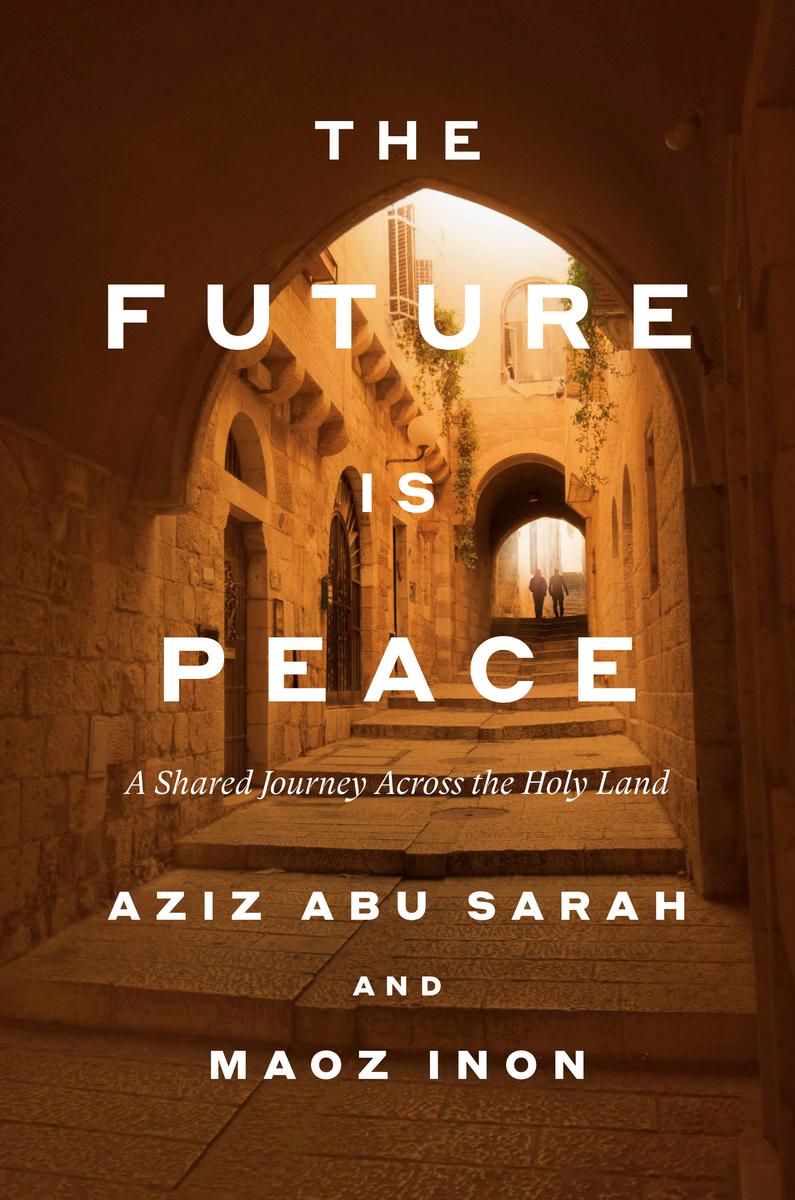
Review of Aziz Abu Sarah and Maoz Inon, The Future is Peace: A Shared Journey Across the Holy Land
by Peter Eisenstadt
This is a wonderful, powerful, and moving book, co-written by an Israeli Jew and a Palestinian resident of East Jerusalem. Most of the book consists of alternating sections, written either by Aziz or Maoz (as they refer to themselves in the book.) Both men come to the book with sad tales to tell. Like many recent books on the Middle East, the authors establish their authority to write on their subject in part by relating their tragic personal histories. Maoz’s parents, Yakovi and BilhaI Inon, were murdered by Hamas on October 7, and their house and their bodies were burnt beyond recognition. Aziz’s older brother, Tayseer, was arrested during the First Intifada for rock throwing, then beaten and tortured in Israeli prisons. He was slowly murdered, in what amounted to death on the installment plan. After several years he was released, only to die of untreated internal injuries several months later. The two men came together after October 7. Aziz is a tour guide, and Maoz was an operator of hostels in East Jerusalem. As a Jew, he overcame much skepticism to establish a hostel in the largely Palestinian Israeli city of Nazareth. Both have extensive histories in joint Jewish-Palestinian organizations. The histories are accurate; the stories are often chilling. Both men look to confederation as the most optimum future for Israeli Jews and Palestinians.
The format of the book is a travelogue, a week’s tour. There are many great stories, many sad stories, told by the authors and their interlocutors. The book opens in Netiv HaAshara, the moshav in which Maoz’s parents were slaughtered, near the border with Gaza. Gaza is unvisitable, barely inhabitable, and looms over the book as the ultimate debacle and desecration in the Hundred Years War between Jews and Palestinians. The tour takes us to the ancient alleys of Jaffa and the broad boulevards of Tel Aviv. It then moves to East Jerusalem, where Aziz grew up, after his family abandoned their home in Bethany, in the West Bank, to obtain Palestinian residency rights in Jerusalem, and where his brother was caught up in the teenage rock throwing of the First Intifada, paying with his life. Maoz and Aziz then go to the West Bank itself, visiting beleaguered Palestinian communities in Area C, under direct Israeli control, and the Palestinian city of Bethlehem in Area A.
The tour includes Nazareth and other places in the Galilee, and with accounts of a Palestinian visit to Yad Vashem, the legacy of Deir Yassin, and the story of Hind Rajab, the five-year old girl murdered by the IDF in Gaza (the subject of an excellent film.) The book ends with Maoz and Aziz, as peace activists, meeting Pope Francis in 2024 shortly before his death. Towards the end of the book Maoz asks its central question, “We are all suffering, all steeped in trauma and loss. How can we transcend the suffering? How can Israelis forgive October 7? How can Palestinians forgive the Nakba or the brutality of the massacre in Gaza?”
Searching for solutions to unanswerable questions through traveling in the Holy Land is a venerable genre. Perhaps no area of the world has been more travelogued, with an estimated 3,500 works written even before the 20th century, including Mark Twain’s “The Innocents Abroad” (1867), his best-selling book during his lifetime, and Herman Melville’s “Clarel: A Poem and Pilgrimage in the Holy Land” (1876), his largely unread poem of 18,000 lines of iambic tetrameter: “Our New World’s worldly wit so shrewd/ Lacks the Semitic reverent mood.” To speak of this part of the world, as do Aziz and Maoz, as the “Holy Land”, is venerable and old-fashioned as well, speaking to the surprisingly Christian framework for this book written by a Jew and Muslim. Several times the authors invoke the beatitudes of the Sermon on the Mount: “Blessed are the Peacemakers, for they will be called the Children of God.” The authors often refer to themselves as peacemakers. Although I suppose if there ever is a single state or a confederation, rather than arguing over whether to call it Israel-Palestine or Palestine-Israel, the designation “Holy Land” has a nice ring to it. (Or my alternative neutral name, Riversea.)
But the most old-fashioned part of the title for me is the word “peace,” mentioned in the book over 300 times. Really? When I think of a better future for Jews and Palestinians, the word peace rarely comes to mind. Perhaps there will be a “rapprochement,” an “amelioration,” an “understanding,” but not “peace.” A future Tolstoy’s novel about Israel and Palestine might be called “War and More War”. Peace is a vague term, with many meanings, of course. There is the victor’s peace, “peace with honor,” the loser’s peace “peace at any price,” St. Paul’s peace that “passeth understanding,” the peacemakers blessed by Jesus, and the “peacemaker”, the popular name for the Colt .45 six-shooter beloved by sheriffs and outlaws in Hollywood westerns. And then there is the peace that according to F.W. Robinson, an Anglican divine writing in 1851 (thank you, Oxford English Dictionary, for the citation) “that is the opposite of passion, labor, and effort. Peace is that state in which there are no desires madly demanding an impossible gratification.” I am not sure what sort of desires the Rev. Robinson was writing about—one can hazard a guess—but peace between Israel and Palestine will require hard effort, difficult labor, passion. It is the epitome of a desire that will be seemingly impossible to gratify.
I am not sure if Maoz and Aziz really like the word peace either. Aziz writes sarcastically about that “magical word peace,” stating that it “doesn’t eradicate the ongoing structural inequalities” that Palestinians “face every day. “ He later scorns people for whom “the word peace brings to mind tie-dyed T-shirts, flowers, and white doves.” Both men insist that being peace activists is like fighting a battle in a war. It is an old paradox, dating back to at least William James’s invocation of social activism as the “moral equivalent of war.” Pacifists often likened their work to the life and death vows and commitments of a soldier, as in the title of the influential 1939 book by the Indian-American Krishnalal Shridharani, “War Without Violence: A Study of Gandhi’s Methods and Its Accomplishments”. For Gandhi, any cause worth fighting for had to be worth dying for. As the authors of “The Future of Peace” note, Jewish and Palestinian activists have been killed, thrown in prison and tortured, rejected and ostracized by friends and family, and sometimes have taken their own lives “carrying humiliation, and struggling not to sink into the darkness of trauma that threatens to pull you down.” Peacemaking has nothing to do with peacefulness.
But “The Future is Peace” has convinced me that, for all my reservations and qualms, now is the time we must talk about peace. One reason is precisely that peace, in its ambiguities is also so encompassing. It can’t be found in a diplomatic demarche. It is a psychological state and a moral conviction to forego and foreswear revenge and hate, and to meet with the enemy without rancor or fear. Perhaps banging swords into plowshares is the easy part. What’s really difficult is, as the Book of Micah hopes, is the ultimate goal of creating a society in which “every person shall sit under his grapevine or fig tree, and no one will feel afraid.” And to achieve peace one must begin to do all of this, all at once.
“The Future is Peace” begins, as have so many efforts in the past, on the micro-level, building trust and cooperation between Israeli Jews and Palestinians through common efforts, directed to shared objectives. And the ultimate objective is not just to recognize the trauma of others, but to acknowledge your own complicity in maintaining it.
This dynamic is always tricky. Israeli Jews have more power. Palestinians have more moral credibility. And both want what the other has. “The Future is Peace” does not minimize the challenge. Jews and Palestinians must find ways to work together while always recognizing that their destinies are both shared and separate, and in some ways pull in opposite directions. Only by working together closely, by integrating, can Israeli Jews and Palestinians create institutions that can truly be separate and truly be equal. (One small example is “The Future is Peace” itself, a co-written book that adopts a “two-voice” approach, with each writing their own sections, along with a few jointly written “confederated” sections.)
In the US, in the South in the 1950s, to ward off civil rights efforts, segregationist governments embarked on what they called “equalization,” providing some additional funds for Black educational institutions without changing the fundamental structures of Jim Crow. A parallel fear is behind the Palestinian fear of “normalization.” As Aziz writes “if our work ignores the reality of occupation, avoids difficult conversations about power, justice, and freedom, and creates a false image of equality when none exists—then that is normalization. But if we build partnerships that directly confront injustice, that put the ending of the occupation at the center, that give equal voice to both Palestinians and Israelis committed to change—then this is not normalization, it’s co-resistance.”
Israeli Jews have to recognize that they do not have veto power over possible change. Palestinians have to recognize that they have no alternative but working with Israelis. Palestinians fear that changes will cease once the all-too easily satisfied consciences of Israeli Jews are salved. Jews will fear that the more they concede to Palestinians, the more they will demand. As Israeli philosopher Avishai Margalit has recently written in Ha’aretz, “Ideals may tell us something important about what we would like to be. But compromises tell us who we are.” This is what English poet Andrew Marvell long ago called “the Inglorious Arts of Peace.”
Over the years I have read, and no doubt you have read, many books like “The Future is Peace”. Good books by decent people, often by an Israeli Jew collaborating with a Palestinian, calling for a better future. This book moved me in a way that few books in this laudable genre have, less perhaps because of its content than its utter timeliness. In the fall of 2026. Another of the paradoxes of the current situation is that the more dire the situation becomes and the more hopeless it seems, the more radical solutions seem possible and necessary. We do not need, as happened in 1948 between Israel and its Arab neighbors, an armistice, a pause in the violence. We need a lasting and durable peace, strong enough to withstand the gale force winds that will endeavor to blow it apart. And we need peace precisely because much of what we once believed in now seems dubious. To be a self-respecting Zionist committed to the best aspects of the “Zionist idea” is, for many, to call yourself a post-Zionist, or some other destination beyond Zionism. A younger generation of peace activists, impatient with decades of inaction, are yapping at our heels, often with very strong arguments. I am reminded of what the great African American religious thinker, Howard Thurman, born in 1899, wrote in 1971, with angry Black radicals accusing their elders, like Thurman, of standpattism in the era of Black Power, often with an epithet that was wielded too easily at the time, “Uncle Tom”:
As the older generation, we have suddenly become aware of our youth, as if for the first time. We are angered by their anger, even though we secretly marvel at the courage of their anger…We are shocked by their failure to respond to our values, even as we are humiliated by our own sense of failure and inadequacy. Nothing seems to hold. Nothing seems adequate to the crisis that is upon us. In our extremity we are tempted to take refuge in old shibboleths that we ourselves have long abandoned. We find ourselves using words that have been forsaken by meaning. … Now, it often seems to us, the younger generation turn and rend us because we have sought to nourish them with the sense of our failure.
The generational crisis in left-Zionism and left-Jewish politics in the United States is of course not identical to the generational crisis in Black politics ca. 1970, but there are similarities. And despite the reality that there are young fogies and old revolutionaries, the dispute has a generational divide. Older activists know that for all of our good intentions, in terms of our ultimate objectives we have been failures, abject failures, for decades. And everyone knows it; friends, foes, and would-be allies alike. What is exciting about pursuing peace is precisely its open-endedness. No one knows where it will lead, except that it will take us to places we have never been to before. The root causes of the Israel-Palestine conflict must be directly confronted and addressed. Pursuing peace is a many-dimensioned thing, with its exacting pragmatism and unbounded utopianism, its need for both street corner agitators and secret conclaves of high ranking negotiators. Israelis and Palestinians must learn how to find inner peace amid outer turmoil or how to accept outer peace while dealing with inner turmoil. This is really the only issue of the day. Peace is built on the political and ideological foundations that we bear and bring to the table, but with the hope that we will be able to transcend them.
Aziz and Maoz invite us to join them. The message of “The Future is Peace” could not be clearer. We all must speak now (and listen now and above all, act now) or be obliged to “forever hold our peace.” Peace can never be held. Real peace is too hot. Its joys and burdens can only be, carefully and gingerly, passed along and shared.
Leave A Comment